
If you came across “ragamuffin” in a book, headline, or conversation, the word usually points to someone who looks ragged, dirty, or poorly dressed. In American English, it has an old-fashioned feel and is especially associated with children. Its history is much stranger than its everyday meaning, reaching from Middle English to a forgotten New York Thanksgiving custom.
| Quick fact | What to know |
|---|---|
| Part of speech | Noun |
| Main meaning | A ragged, untidy, or poorly dressed person, often a child |
| Register | Old-fashioned and informal |
| US pronunciation | RAG-uh-muf-in |
| Plural | Ragamuffins |
| Origin | Middle English |
| Related senses | Ragga music, a domestic cat breed, and historical parade traditions |
| Tone | Can be playful, affectionate, dated, or insulting depending on context |
Direct answer: This old-fashioned noun describes a ragged, untidy, or poorly dressed person, especially a child. In modern American English, it can sound playful or affectionate when describing a scruffy appearance, but it can also feel insulting if used seriously about someone’s poverty, cleanliness, or social status.
Key Takeaways
- The word usually describes a scruffy or poorly dressed person.
- Dictionaries commonly mark it as old-fashioned or dated.
- It is a countable noun, and the plural form ends in –s.
- Its precise medieval origin is uncertain.
- American history gives the term an unusual connection with Thanksgiving.
- The same spelling also appears in music and as the name of a cat breed.
What Does Ragamuffin Mean in Modern American English?
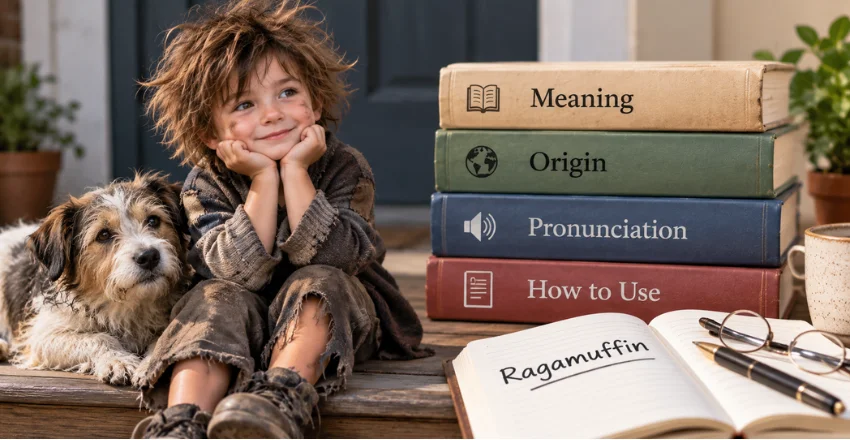
The simplest definition is a person who looks ragged, dirty, or badly dressed, with children being the traditional example. Collins, Oxford, Cambridge, and Merriam-Webster all give closely related definitions. Several also mark the noun as old-fashioned, which is useful when deciding whether it sounds natural in present-day conversation.
Today, a speaker may use the term with more warmth than older dictionary definitions suggest. A parent might jokingly describe children who return from playing outside with muddy clothes and messy hair. In a harsher context, though, the same label can suggest poverty, neglect, or disreputable behavior, so tone matters.
That distinction makes the word more useful in storytelling than in neutral description. It can quickly create an image of torn clothing, untidy hair, street life, or cheerful disorder. Writers should still consider whether scruffy, unkempt, messy, or shabbily dressed would communicate the idea with less judgment.
Readers interested in careful word choice can also see Writinglish’s guide to the meaning and use of “unconscionable.” That article shows how a word’s tone can carry more meaning than its basic dictionary definition. The same principle applies here because context determines whether the noun sounds affectionate or dismissive.
Pronunciation, Grammar, and Spelling
In American English, the pronunciation is commonly represented as RAG-uh-muf-in. Dictionary IPA transcriptions vary slightly in presentation, but they point to essentially the same spoken form, with the main stress near the beginning. You do not pronounce the second half like the baked food “muffin” with a separate, emphasized stress.
Grammatically, the word functions as a countable noun. One person can be described with the singular form, while a group takes the regular plural ending. The alternative spelling “raggamuffin” also appears, particularly in connections with Jamaican music and culture.
Five common ways you may encounter the noun are
- Describing a child wearing torn, dirty, or oversized clothing.
- Playfully referring to someone who has become muddy or disheveled.
- Creating an old-fashioned street-child image in fiction.
- Referring to historical American Thanksgiving customs.
- Appearing in specialized names connected with music or cats.
Where Did the Word Come From?
The history reaches back to Middle English, but scholars do not have a completely settled explanation for every part of it. Medieval forms included spellings such as Ragamoffyn, and the word appeared in William Langland’s Piers Plowman as the name of a demon. The connection between the first element and “rag” or “ragged” is plausible, while the origin of the ending remains uncertain.
Etymonline traces an early sense meaning a demon to the mid-14th century and a sense referring to a ragged person by the late 14th century. Merriam-Webster also describes the word’s history as uncertain and notes its use in Middle English for a ragged or oafish person. Together, these sources show that a simple “rag plus muffin” explanation sounds more certain than the historical evidence supports.
The specific association with poorly clothed or dirty children developed later and became the meaning most familiar to modern dictionaries. That history helps explain why the noun can sound literary, historical, or deliberately old-fashioned today. For more vocabulary-focused material, readers can browse the Writinglish Education section.
Ragamuffin Day and a Forgotten American Thanksgiving Tradition
The term has a particularly interesting place in the cultural history of the United States. In New York City, children once celebrated a Thanksgiving custom commonly called Ragamuffin Day, dressing in rags, oversized clothing, masks, or exaggerated costumes. They walked through neighborhoods and asked adults for pennies, fruit, candy, or other small gifts.
The New York Public Library reports that the custom was established by the late nineteenth century and was already familiar enough to be discussed in newspapers by 1909. Children sometimes asked passersby a phrase similar to “Anything for Thanksgiving?” as they moved through the streets. The tradition eventually drew criticism because adults and officials objected to children begging for money and gifts.
By the 1930s, the practice was losing ground, while organized parades and other holiday customs became more prominent. The Library of Congress also preserves photographs and historical material related to Thanksgiving masking and ritual begging. This American history adds a layer that brief dictionary definitions often leave unexplored.
Is the Word Rude, Affectionate, or Insulting?
The safest answer is that context controls the tone. Calling a muddy child “a little scruff” after an afternoon outdoors can sound affectionate, and this noun can work in a similar playful way. Vocabulary.com, for example, notes that modern usage can carry an affectionate sense connected with a disheveled appearance.
The same expression can become insulting when it targets a stranger’s poverty, hygiene, clothing, or social position. Older meanings also carried stronger associations with disreputable or beggarly people. For neutral modern writing, choose a more precise description when there is a risk of sounding dismissive.
| Alternative | Best fit | Tone |
|---|---|---|
| Scruffy | Messy appearance or clothing | Informal, usually mild |
| Unkempt | Neglected hair or appearance | Neutral to negative |
| Shabby | Worn clothing or surroundings | Neutral to negative |
| Waif | A vulnerable or neglected person, often a child | Literary, dated |
| Urchin | A mischievous or poor street child | Old-fashioned |
| Disheveled | Untidy hair, clothes, or appearance | Standard and descriptive |
Using the right alternative depends on what you want to emphasize. Disheveled focuses on appearance, while shabby often focuses on worn clothing or condition. Urchin and waif carry their own historical and social associations, so they are not automatic replacements.
Other Meanings: Music and the Cat Breed
The spelling also developed meanings outside ordinary vocabulary. Oxford records the term and the variant “raggamuffin” in connection with ragga, a West Indian dance-music style influenced by reggae and hip-hop. This musical sense is specialized, so surrounding context usually makes it clear that a writer is not describing somebody’s clothing.
Ragamuffin is also the name of a domestic cat breed known for its large build, long coat, and affectionate temperament. The breed developed from Ragdoll lines in the United States and became recognized separately during the 1990s. Readers researching the animal rather than the vocabulary term can also explore the Writinglish Pets section for related pet content.
How to Use the Word Naturally in a Sentence
This noun works best when the reader can clearly understand whether the tone is humorous, descriptive, or historical. It is less suitable when you need an objective description of someone’s economic circumstances. These examples show several natural contexts without treating every use as interchangeable.
- The children returned from the creek looking like a cheerful group of muddy little ragamuffins.
- The novel follows a young ragamuffin who survives by running errands around the city.
- After camping for three rainy days, Ben laughed at his torn jeans and wild hair.
- Historical photographs show costumed children taking part in old New York Thanksgiving customs.
- Her costume created the deliberately shabby appearance of a nineteenth-century street child.
- The author chose an old-fashioned noun to make the scene feel as though it belonged in another century.
When writing your own example, decide first whether the point is appearance, poverty, humor, or historical atmosphere. That choice will tell you whether this dated noun is useful or whether a simpler modern adjective would work better. Precise vocabulary usually makes prose clearer than selecting an unusual word only because it sounds colorful.
Frequently Asked Questions
Is “ragamuffin” an insult?
It can be, although it is not automatically offensive. A playful use among family or friends may refer only to messy clothes or hair, while a serious label directed at someone can sound demeaning. Avoid it when the wording could mock poverty, homelessness, hygiene, or a person’s social status.
Is this word still used in American English?
Yes, but major dictionaries commonly describe it as old-fashioned or dated. You are more likely to meet it in literature, historical writing, playful conversation, or descriptions meant to create an old-time atmosphere. Words such as “scruffy,” “messy,” and “disheveled” are usually more natural in ordinary modern speech.
What is the plural form?
The plural is formed normally by adding -s. There is no irregular plural or spelling change required. As with the singular form, the plural tends to sound old-fashioned when it describes people.
Does the word always describe a child?
No, although children are strongly associated with the traditional definition. Dictionaries also allow the broader meaning of a ragged or poorly dressed person of any age. The surrounding sentence usually tells you whether the speaker means a child specifically.
Why does the word appear in searches about cats?
A capitalized form is the official name of a domestic cat breed, so a one-word search can produce both dictionary pages and pet information. The ordinary noun and the breed name, therefore, share a spelling but refer to different things. Checking the surrounding context quickly resolves which meaning is intended.
Use the Word With the Right Tone
This unusual noun has survived for centuries because it creates a vivid picture, but its age and social associations make context especially important. Use it for historical writing, literary atmosphere, or lighthearted descriptions when the tone is clear. For everyday neutral writing, a precise alternative such as “scruffy,” “shabby,” “unkempt,” or “disheveled” will often communicate your meaning more directly.
For more explanations of unusual words and their real-world usage, continue through the Writinglish Education section. Learning the definition is useful, but understanding a word’s tone, history, and appropriate context is what lets you use it confidently.