
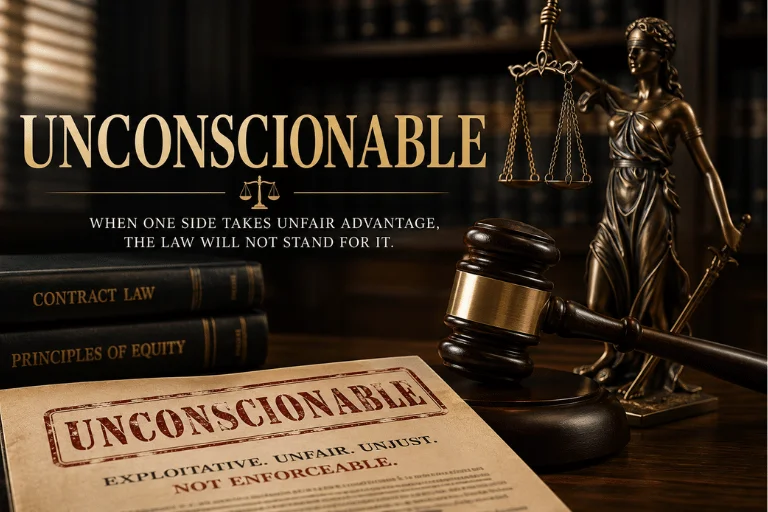
When ordinary words such as “unfair” or “unreasonable” feel too weak, English has a stronger choice for conduct that crosses a serious line. Unconscionable is a formal adjective that describes something so unfair, immoral, unreasonable, or excessive that it seems impossible to defend in good conscience. You can use it to describe conduct, decisions, prices, demands, or contract terms. In everyday English, it expresses a stronger moral judgment than words such as “unfair” or “unreasonable.”
| Unconscionable | What to know |
| Part of speech | Adjective |
| Main meaning | Shockingly unfair, immoral, or unreasonable |
| Secondary sense | Excessive or far beyond reasonable limits |
| Tone | Formal and strongly disapproving |
| Common uses | Conduct, behavior, fees, prices, demands, terms |
| Related noun | Unconscionability |
| Related adverb | Unconscionably |
The adjective is commonly used in formal and disapproving contexts. It often describes conduct that is shockingly unfair or unjust. It can also refer to high costs, demands, or amounts.
Key takeaways
- The word describes something far worse than mildly unfair.
- It often carries a moral judgment about a person’s actions or decisions.
- It can also describe a price, fee, demand, or amount that seems outrageously excessive.
- It is more common in formal writing, criticism, journalism, and legal discussion than in casual conversation.
- In law, the term has a narrower meaning connected with seriously unfair contract terms or bargaining conditions.
What does the word really mean?

The easiest way to understand the word is to connect it with conscience. Your conscience is your sense of right and wrong. Something described as unconscionable is so objectionable that accepting or doing it would seem incompatible with a reasonable moral conscience. That makes the term much stronger than unfair. A delayed reply might be inconsiderate. An unequal rule might be unfair. Exploiting a vulnerable person for personal gain could deserve much stronger condemnation.
There is also a less strictly moral sense. The word can describe amounts or demands that go far beyond reasonable limits. An outrageous fee or an extreme price can fit this meaning even when the speaker is focusing on excess rather than personal morality. This flexibility explains why the adjective appears in discussions about ethics, business practices, prices, policies, employment conditions, consumer treatment, and contracts. For a closer look at this, see Next of Kin Meaning in the U.S..
How to pronounce unconscionable
The pronunciation can seem intimidating because the spelling contains several syllables that are not pronounced exactly as they appear. The main stress falls on the second syllable. Do not pronounce the middle of the word as though you were separately saying science. Connecting the spelling with the conscience can also make the pronunciation and meaning easier to remember.
How to use “unconscionable” in a sentence
The adjective normally describes an action, policy, condition, demand, amount, or type of behavior.
For example:
The company charged an unconscionable fee to customers who had almost no practical alternative.
Here, “unfair” would convey the basic idea. The stronger adjective signals to the reader that the speaker considers the fee so extreme as to warrant moral condemnation.
The term also works naturally before nouns such as “conduct,” “behavior,” “price,” “profit,” “delay,” “demand,” “policy,” “contract,” and “clause.”
Before choosing it, ask yourself three questions:
- Is the situation far beyond ordinary unfairness?
- Is strong condemnation appropriate?
- Would a calmer word such as “unreasonable” communicate the meaning accurately?
If the answer to the last question is yes, the stronger adjective may be unnecessary.
This distinction matters in academic and formal writing. Strong vocabulary works best when its intensity matches the evidence. Readers working on essays can also explore Writinglish’s guide to Things to consider before filing for divorce in Montgomery.
Synonyms and the differences between them

A synonym should match the exact shade of meaning you want. Possible alternatives include unethical, unfair, unjust, outrageous, unreasonable, and excessive.
| Alternative | Best used when you mean | Strength or emphasis |
| Unfair | Someone is not being treated equally | Broad and common |
| Unjust | A decision violates fairness or justice. | Stronger and often principled |
| Unethical | Conduct violates moral or professional standards. | Focuses on ethics |
| Unreasonable | A demand or decision lacks sensible limits. | Less morally charged |
| Outrageous | Something causes shock or anger. | Emotional and forceful |
| Excessive | An amount, cost, or action goes too far. | Focuses on degree |
| Exploitative | Someone benefits by taking advantage of another person. | Focuses on abuse of power |
These alternatives are not interchangeable in every sentence. For example, an excessive price may simply be much too high. Calling the same price unconscionable suggests a stronger accusation about how or why it was imposed. That difference is why careful word choice matters. A stronger adjective does not automatically make writing better.
What “unconscionable” means in law
Legal writing gives the word a more specific role. In contract law, unconscionability can describe a contract or clause that is seriously unfair or oppressive. Courts may consider both unfairness in the bargaining process and unfairness in the contract’s terms. In some legal systems, a court may refuse to enforce a seriously unfair contract or clause, remove the offending provision, or limit how it applies.
That does not mean every bad deal receives this legal label. The doctrine has specific legal requirements, and the rules can depend on the jurisdiction and the facts of the case. Readers interested in legal topics can browse the Writinglish Law section for related educational material.
Where the word came from

The history of the word makes its meaning easier to remember. The adjective has been used in English for centuries to describe actions that show little or no regard for conscience. A sense referring to something beyond reasonable limits also developed early in the word’s history. The older positive form of conscientiousness still exists, although it is much less familiar today. The modern word has therefore maintained a strong connection with the idea of conscience for centuries.
Common mistakes to avoid
One frequent mistake is confusing this adjective with unconscious. The two words look similar, but they have completely different meanings. “Unconscious” usually means not awake or not consciously aware. Unconscionable, by contrast, concerns fairness, morality, or extreme excess. Another mistake is using the adjective for every minor inconvenience. A five-minute delay or a disappointing meal is rarely serious enough to justify such a strong word unless the speaker is deliberately exaggerating.
Writers also sometimes use the word when expensive is all they mean. A high cost alone is not always enough. Words such as “excessive,” “overpriced,” or “unreasonable” may express the intended meaning more accurately. Finally, remember that the base form is an adjective. The related noun is “unconscionability,” while “unconscionably” is the adverb. More from us: Adultery Meaning Made Clear.
Use strong words with precision.
This adjective earns its place when unfair does not communicate enough. It tells the reader that an action, demand, price, or decision has crossed a serious moral or reasonable boundary. Use it selectively, and the force of the word remains intact. For more learning-focused material, browse the Writinglish Education section.
Frequently asked questions
It means so unfair, morally wrong, unreasonable, or excessive that it is difficult to defend. The word expresses stronger disapproval than everyday choices such as bad or unfair.
Yes. It is mainly used in formal or strongly disapproving contexts. It fits naturally in essays, reports, journalism, criticism, serious commentary, and legal discussions.
Yes. It can describe a price, cost, fee, profit, or other amount that seems excessively high or unreasonable.
For example:
The landlord demanded an unconscionable fee from tenants who had no realistic alternative. The word suggests more than simple expense. It implies that the amount crosses a serious boundary of fairness or reasonableness.
No. Its everyday English meaning is broader than its legal meaning. You can use the adjective to describe morally unacceptable conduct, extreme demands, unfair treatment, or excessive charges without discussing a contract or court case.
Depending on the sentence, useful opposites include fair, reasonable, ethical, just, or acceptable. The best choice depends on whether you are emphasizing morality, fairness, or degree.
Taking advantage of someone vulnerable, imposing deliberately unfair conditions, or demanding an extreme payment from a person with no realistic alternative could be described as unconscionable behavior. The term works best when the conduct goes far beyond ordinary unfairness.